• This great research paper of Marcel Nemec “Catharsis – philosophical and spiritual aspects of long-distance running” really caught my attention (Acta Facultatis Educationis Physicae Universitatis Comenianae, 42-52; Vol. 56 No 1 2016). The findings showed that catharsis represents a relevant philosophical and spiritual aspect that influences long distance running. The authors assume that an authentic experience of catharsis and its effects motivates runners to perform regular physical activity. The analysis of the philosophical and spiritual aspects of distance running revealed a multispectral holistic relevance based on the transfer affecting a specific way of life, a spectrum of values, ethical personality traits, and also the quality of long distance runners’ lives. The aim of the study was to identify and analyze the occurrence of cathartic states in a sample of long-distance runners. Data collected through questionnaires were used to quantitatively assess variables in the context of philosophical and spiritual aspects of long distance running.

    According to them, long distance running events fall into the category of track and field and are determined primarily by endurance. Long distance running puts a lot of emphasis on voluntary effort in both training and competition and requires a balanced type of personality. The runner is endowed with high levels of perseverance, patience and tolerance for monotonous physical activity. In terms of training requirements, education towards self-reflection is an integral part of a runner’s long-term training preparation. To perform physical activity in nature, where these runners appear, there is considerable volume in their training. Nature enables inner purification – catharsis, renewal of the essential and natural connection with oneself, with other people and with the world.

    Catharsis (purification) refers to a concept that comes from ancient Greek aesthetics, which characterizes the aesthetic effects of art on man. Catharsis probably includes both physiological moments (relief of emotional tension) and ethical moments (cultivation of human emotions) that are synthesized in an aesthetic experience. Catharsis in sports is related to emotional states of depletion following sports performance, for example when an athlete feels satisfied after performing a sustained sporting activity.

    Catharsis is also known as purification, which represents complete awareness of oneself and thus what “his life really represents”. The spirituality of sports allows us to study the general sense of spirituality that is applied and embodied in the practice of sports and also how specific religious movements in their interpretation of spirituality are related to sports. They add that the meaning of spirituality deviates significantly from the original Christian discipline to seek spirituality that is not influenced by religion. Spirituality can become not only a symbol of religious beliefs, but also a way of searching for the feeling of life, perceiving the depth of life through ethical and aesthetic exposure to the dimensions of the world, longing for harmony and a transcendental experience. Nemec’ and his colleagues assume that the structure of people’s motivation to run, and also to participate in mass running events, includes a spiritual dimension of running that is perceived by the personality of the runner.

    In the specific study conducted by Nemec’, the sample included 74 runners, 48 ​​men and 26 women. The average age of the runners who were active participants in running events in 2014 was 26 years. A relatively young age for the amateur ultra runners I know. The runners filled out a questionnaire in order to collect data on cathartic situations they experienced.

    Over ninety percent of the runners testified to a feeling of “purification” during the run. This feeling is attributed to the feeling of well-being that comes from neutralizing negative feelings during the aerobic running phase. This is indeed an authentic experience for the runners. A similar percentage reported “inner peace” during the run. This feeling is also attributed to the neutralization of negative emotions. The authors claim that this sense of continuous inner harmony is one of the goals of the runners’ ongoing spiritual activity.

    The researchers tested the peak sense of harmony by asking the runners if they experienced a deep connection with the external environment while running. Here the percentage of positive respondents decreased to seventy percent, and the claim is that the decrease is due to the fact that it is more difficult to neutralize external influences from the whole experience. But what did the runners think of themselves at the end of the run? Were they satisfied with themselves? Here about seventy percent answered positively. The researchers claim that the reason for this is that running such distances is not seen as a necessary sacrifice for the purpose of training for “health” or “weight loss”. In their opinion, the reason is that these runners experience running as a complex activity that affects all dimensions of their lives, the essence of their existence.

    Particularly interesting are the runners’ references to the role of running in their lives beyond the physical activity. A third of the runners reported that in addition to being physically active, running for them is a form of internal purification. In the case of these runners it strengthens perception and understanding of philosophical and spiritual aspects of long distance running. Fifteen percent of the runners reported that in addition to being physical, active running represented a form of self-fulfillment for them. In this context, it is assumed that the term “self-fulfillment” is understood from the perspective of striving for performance as an achievement of a sporting level (breaking a personal record, achieving a certain time limit), or obtaining an expected position in a competition, or as participating in a major sporting event (participating in a popular marathon race). This group of runners may be considered a hidden group of runners, who may approach philosophical and spiritual aspects of running through their authentic experience.

    When asked…

    Many of the runners reported two most powerful experiences while running – self-satisfaction and self-conquest. Cathartic aspect in the context of long distance running and the experience of self-satisfaction may be expressed metaphorically as “fulfillment of a goal” through successful participation in a race.

    A demanding training load. Hertz’s experience of self-conquering probably occurs out of overcoming critical situations caused by fatigue and exhaustion. Successful handling of such critical situations is perceived by the runners as a satisfaction related to overcoming the decisive factor of the situation. Critical situations accompanied by physical and mental exhaustion expose the runners to an authentic confrontation with the perception of hidden dimensions of life and allow the runners to deal with the field of philosophical knowledge, or with a spiritual field of experiences. Ten percent of the runners reported states of self-awareness, euphoria and joy as the strongest experiences. These statements by runners indicate philosophical and spiritual aspects of long-distance running, which are to some extent influenced by cathartic processes.

    The researchers conclude that the research findings showed that catharsis represents a spiritual and philosophical aspect that affects long-distance running. They assume that an authentic experience of catharsis and its effects motivate runners to perform regular physical activity. This analysis of philosophical and spiritual aspects of long-distance running revealed a holistic relevance based on transference affecting a specific way of life, a spectrum of values, ethical personality traits, and also the quality of life of long-distance runners.

  • When people try to crack psychological questions, I guess many are familiar with the question “What would Freud say about this?”. But psychoanalysis as I know it (and I am of course not a n expert) devotes itself to scientific “truths,” and tends to negate spirituality or experiences. I guess because of my character, and also because of my professional past in research and academia; I move uncomfortably in my chair whenever professionals hold “unquestionable” insights. After all, it is clear to us that we are not always right, and that the truth does not belong to individuals of virtue. This can happen in the exact sciences and in natural sciences, but it is doubly true in the humanities. This assumption also does not miss psychology – the study of the mind and behavior, as these are determined in relation to society as a whole. Therefore, Jung with his groundbreaking thinking, thanks to which he was actually boycotted by Freud and to this day is treated as an esoteric footnote in many faculties of psychology. Jung caught my attention.

    As I wrote before, one of the most powerful experiences in the “4 Deserts” race in Namibia in late 2021 was the “here and now” feelings and a very clear sense of the deep psychological process I am going through during the race. Maybe it’s the stage in life, the fact that it was the first race after a damn period of COVID, and maybe the intensities of the race with the difficulty, the heat, the route, and the demanding terrain. These made me think of another side to endurance events. True, the dimensions of physical, mental and technical preparation for a race are well known and reviewed. The conduct during the race in everything related to mental and mental coping also wins books, articles and even workshops. Even therapeutic dimensions of running as a method of psychological treatment are documented in the literature and used. What I did not notice is documentation, analysis, or an attempt to interpret deep mental processes of people who is dealing with extreme endurance events. For me it is he deep psychological process tat happens underneath and is realized only after the race.

    Jung tended to incorporate the mystical approach of human psychic analysis as opposed to Freud’s analytical approach. In his Red Book he tried to test his theories in self-analysis. He tried to understand the internal navigation system. Emotions, thoughts, behavior – the connection between the conscious and the subconscious – is the way to become a perfect person. He argued that man’s purpose is to understand the expression of the subconscious that floats to the surface, and that the purpose of his existence is to illuminate the darkness of just being “the sole purpose of human existence is to kindle a light in the darkness of mere being.” For him there is a continuous connection between the conscious and the subconscious, and a huge part of what we get comes from our parts that we do not know. Therefore, the process of individuation, in which a person understands his actions in the process of understanding consciousness – is critical to the person.

    Its basic division is into the conscious, the individual subconscious, and the collective subconscious. Awareness is how one identifies oneself, in which the ego is also the story you tell yourself about yourself, and sits in the persona that is your expression towards the environment. This phrase is different from who you really are. The ego filters different dimensions – and these dimensions are a big part of the subconscious. I think the experience of endurance, as deep as it is, peels off the layers of our ego in itself. Until we stand naked in front of our own eyes. I know many moments where I tell myself an alternate story in my head to make it easier to deal with the race – and immediately afterwards reprimand myself for the lie I make in my mind.

    The subconscious, according to Jung, is both personal and collective. The personal, corresponds continuously with the conscious. However, according to Jung there is also a collective subconscious, which largely sums up the historical experiences of humanity as a biological evolution. Man has evolved this consciousness over the generations, but this evolution has not been completed because there are many more hidden layers in our subconscious. According to Jung each person inherits these patterns, and he bases this on recurring motifs he has found among many of his patients. Even crosses cultures that have not been exposed to each other.

    These dimensions work in parallel to create the self, what you really want, crave, what you really are. According to him, getting there is what creates a full life. This is also the goal of the individual: to try to get there, to accept yourself out of personal sincerity at the highest level. Recognize that we are not always what we think or what we want. When the shadow is not gone by not looking at it there is no movement that separates the individual from his own shadow. The shadow is part of your nature and only at night there are no shadows. That is why you need to know it and to take care of it. This of course is not a simple process, and probably not really possible.

    Jung saw the man of our time blind to the fact that with all his rationality and efficiency, he has “powers” beyond his control. His gods and demons did not disappear at all; They only have new names. They keep him running with restlessness, vague fears, psychological complications, insatiable need for pills, alcohol, tobacco, food – and above all, a large array of neuroses. He argued that whenever there is a descent to the innermost experience, to the core of the personality, most people are overcome by fear and many flee. . . The risk of an inner experience, the adventure of the spirit, is foreign to most human beings anyway. The possibility that such an experience may have a psychic reality is a horror to them. “Life calls us forward to independence, and anyone who does not listen to this call because of childish laziness or shyness is threatened with neurosis. And once it breaks out, it becomes an increasingly valid reason to run away from life.”

    These statements fascinate me because for me they symbolize the great challenge in our lives. Really accept your shortcomings, your weaknesses, what you see or fear in others. Admitting that you are not necessarily as perfect as you think. It is a shaky experience but essential to a full and complete life. Not only fix the bugs in your operating system, but also a tool to fix the control system to re-enter the coordinates that will lead you to where you want to be.

    Jung saw great importance in dreams. According to him, dreams are the impartial spontaneous products of the unconscious mind, out of the control of the will. They are pure nature; They show us the colorless natural truth, and are therefore appropriate, like nothing else, to give us back an attitude that conforms to our basic human nature when our consciousness has gone too far from its foundations and stumbled upon a dead end. An interesting statement attributed to Jung is that “the facts of nature cannot be violated in the long run. Penetrating and infiltrating anything like water, they will undermine any system that does not take them into account, and sooner or later bring about its downfall. That the spirit is a part of it – should not fear premature decline. “

    His statement that the difference between the “natural” process of “unconscious” individuation and that which is realized consciously is enormous. In the first case, consciousness does not intervene anywhere; the end remains as dark as the beginning. In the second case, so much darkness comes to light. “The personality is imbued with light and consciousness necessarily gains scope and insight. The encounter between the conscious and the unconscious should ensure that the light shining in the darkness will not only be perceived by the darkness, but will understand it.” Left me pondering, trying to figure out if the process I was trying to figure out belonged to the first or the second. And maybe my personal experience is exactly the moment when the process becomes a conscious process.

  • As I delved deeper into reading and learning on the subject, I was intrigued by Prof. Miller’s first diagnosis, which saw spirituality as a tool for protection from suffering. Therefore, the moment when she first points out that suffering and difficulty are in fact a process of building spirituality was particularly interesting. I wonder maybe this is actually the experience I feel during endurance racing? That, and the connection to the description of the case she brings began to make the picture clear to me.

    In answer to her question “Have you ever felt spiritual?” One season patients “yes!”. She describes her feeling when she is in nature or just outside, appreciating a beautiful moment. The feeling as she stands in front of the sea and suddenly feels like she is a wave. A feeling of flow, like a slow motion movie, everything is dreamy and flowing. And then at that moment, she says, “I felt like I’m part of something much bigger.” And she thinks, “I’m here, I feel like I’m just myself. But then the patient added: But it is not scientific… and I believe in science… “. And again rationality strikes me.

    Happily, Prof. Miller does not give up, and in a series of MRI studies she finds that the neural structure of people with a high spirituality or belief index is healthier than that of people with a moderate index. The same “red brain” of high spirituality with wide areas of cortical thickness – is related to the moderating effect of spirituality, how some of us are protected from depression as we go through a development window of risk. The conclusion we have at each step is greatly affected by our spirituality and ability to cope with the moment. Her interesting findings indicated that people who are sensitive to depression are also more sensitive to spirituality, and even benefit more from it. Furthermore, the research team found that the area below the baseball cap base – or if you will the dome – is essential to our ability to develop spiritual awareness.

    In interviews with different people, she identifies a common narrative that is mainly ‘light’ and ‘sky’, and a sense of “one” between the individual and the environment. Common descriptions are “you are part of everything around you and it is all part of you” or “you are connected to trees, rocks, mountains, sky”, and more. Again, the emphasis is on a sense of being a part of something bigger than you. There was a unique meaning to the physical and emotional experience. Some interviewees explicitly referred to these feelings as part of attending a sporting event.

    As they delved deeper into studies that incorporated questionnaires, experiments with advanced technologies of brain imaging and biological evidence increased. Deciphering findings leads them to the conclusion that the spiritual experience of the brain can be seen in three significant ways:
    – Involuntary reorientation of attention
    – A sense of love or a hug that is consistent with an intimate connection or attachment
    – A sense of self that is both distinct and part of the greater oneness

    fMRI studies have clearly shown that we have two forms of awareness, and that they are available to us simultaneously: achievement awareness and stimulus awareness. Achievement awareness is the same sense that our goal is organization and full control over our lives. It is a useful and even essential awareness of our existence. However, if we make exclusive use of this awareness then we are paving the way for anxiety, stress, and depression. We live our lives solely through our accomplishments.

    On the other hand, when we involve the arousing awareness we use a different part of the brain, and actually shed more light, and perform information integration from many sources simultaneously. Instead of thinking that our path depends only on what we create ourselves, we become more “path seekers.” We explore a larger space and ask what life shows us now. In fact, in this way we open up to more possibilities, understand the connections between different dimensions in our lives, are open to leaps and insights, and are connected to purpose and meaning. Integration between things is the key. The same delicate balance between our two types of awareness.

    As their research progressed, Prof. Miller and colleagues focused on an element of striving for long-term spirituality: the same connection between neural and perceptual abilities in the state of “Quest.” They characterize it as a propensity for a journey in life: the search for answers to meaningful decisions in life and meaningful existential questions; Openness to change and even more… Perception of doubt as a positive thing, openness to a fresh look at things, and using experience to drive change. All this to the point of change which is a kind of openness to a personal “version update”. Their study in the Diffusion tensor imaging technique showed that people reported that they were living on a journey – had a better brain connection than others. They showed this by the integrity of the white matter in the brain, including in the areas that connect the two hemispheres.

    A good connection between the brain regions is a sign of health. The information flows, and the mind is open to receiving new inputs – a place to repeat the same old record over and over again. According to her, there is a lively dialogue between thought, perception, orientation and reflection. Many forms of perception work in parallel, all working together. In fact, she argues, a situation of a “journey” in which the mind performs the same vital integration between achievement awareness and stimulus awareness. As a result of the same integration – we literally see more.

    Prof. Miller’s personal and professional journey has left me speechless. The cynical skeptic within me was embarrassed by the scientific evidence, supported by experimental research that brings biological and neurological evidence to the stage of spirituality and allows for a discussion that goes beyond the interpretation of observing behaviors. Wow. There is much more here than that moment in the desert. I find here many layers of explanations for life itself. And maybe that’s what running gives us?

  • During my search to find the deep psychological processes that are part of long endurance races, I found Carl Jung extremely interesting. Especially since he brought spiritualism into psychology. But I would probably discuss this in another post. Anyway… “No one really teaches Jung in psychology classes,” Lilach told me. Freud, for his own reasons, was able to exclude Jung from the academic discourse in psychology. So far freedom of opinion in the world of research…

    I find it difficult to accept this possibility, and seek reference to Jung in the world within the institutionalized academic world, and find to my surprise a course that teaches Jung’s teachings as part of the Spirituality, Mind, Body Institute. The institute operates (Heavenly Sky) at the prestigious Columbia University in the USA. It is headed by the founder Professor Lisa Jane Miller. As someone who deals with evidence-based science and experiments most of his life, it fascinates me to read that spirituality is a protective factor against mental illness, a source of resilience in cultivating relationships and a gateway to personal fulfillment. The more I read the more I am exposed to fascinating research, which relies on a long series of comprehensive clinical studies, pointing to evidence of the biological existence of spirituality!
    The institute’s website states that:

    Science has shown that through suffering we can deepen our spiritual awareness to a more awakened understanding of life. Our work in mental health seeks to put that science into practice. An effective partnership exists between traditional mental health and the clergy for people who are deeply engaged in their faith tradition. However, there are many people who wish to integrate spirituality outside of a faith tradition into treatment, prevention, and wellness work. The Spirituality Mind Body Institute is a hub for the formation of innovation in spiritually integrated wellness work.

    We have created the spiritual awareness pedagogy, which has been offered as a training in spirituality and psychotherapy through the American Psychological Association (APA). This pedagogy has become the basis for our Awakened Awareness program, which we have offered in undergraduate and graduate settings, at The Pentagon, and in industry settings. Delivered in the language of life, Awakened Awareness wakes us up to our own capacity, to knowing our brain as having the potential to be an awakened brain and our own inner life as the docking station for awareness.

    Research demonstrates that spirituality and religion positively impact health and wellness across the continuum of care. In prevention, treatment, and the experience of severe and recurrent mental illness, both primary and co-morbid outcomes are improved when the patient and their family receive spiritual and religious support. Understanding the critical intersections of spirituality and mental health can increase the overall effectiveness and quality of treatment across an individual’s continuum of care.”

    Is this Cosmic timing – Synchronicity? – In 2021, Professor Miller published her fascinating book “The awakened brain” or in its scientific description “The psychology of spirituality and our search for meaning”. In the book she combines her research journey with the personal one to describe the advanced approach she has instilled in the analysis of spirituality and its importance to human health and integrity, using advanced analytical tools, and strong biological connections.

    One of the questions that bothers her in the beginning is why even when we are at the height of success many of us still feel that something is missing there. According to her, when we wake up we feel more whole and “at home” in the world, and our decisions are made from a broader perspective. In her view, spirituality can be the same moment of amorous connection to someone or nature. Awe or a moment of inspiration from something bigger than you. It can be a force majeure, but also nature, the universe, a concert or even a sporting event. These connections, according to Miller, make us healthier: less depressed, anxious, and on the other hand more optimistic, mentally immune, and creative.

    It is interesting to learn that part of her personal journey also included the world of running, where she tells how she learned that in order to finish a marathon “you just have to keep running” … how she was amazed by the variety of runners from all over the world. She describes her love for the long runs of many miles. The stage where enlightenment comes, worries fade, and how in a flash, in an instant, come insights and clarity, an answer to a question, a solution to a problem, or just peace. She describes running as a way of experiencing life in a different way from the achievement orientation of everyday life. How did the feeling become more like the wonder she felt as a child… here too she stops and asks: What floods these experiences? What is really going on in the mind? Why do these moments remove the stress and worries? Does everyone feel that way? … Here I stopped reading – these are questions so similar to my own! Prof. Miller adds and wonders if there are other ways to see reality in this way. What is the internal mechanism that fuels this joy of long runs?

    Her early findings indicated a link between mother-child spirituality and an eighty percent lower risk of depression in the child. At the same time, a researcher named Kandler points out for the first time that spirituality is not necessarily related to religious belief. Moreover, it shows that there is an inherited connection of spirituality. Findings from other researchers have suggested a link between spirituality and suicide. Thus, the community of researchers who examined spirituality as a significant component expanded, and the findings also multiplied and indicated that people who are more open to new experiences are spiritual people.
    To me, all of these were indicators, but as an experimentalist I lacked conclusive proof. And here came Prof. Miller’s fascinating in-depth study of the question: Is it possible to see the awakening mind, the same spirituality, also physiologically? And can we then help people by doing so?

  • As I search more and more among psychologists and philosophers, I discover more and more material that deals with running and spirituality. I first noticed this when I started reading more of what Timothy Olson says, lives, and does. Slowly more and more information accumulated.

    I first tried to understand what Spirituality is, because me and spirituality is something I can not connect, at least not consciously, certainly not to its New Age format (without offending anyone). According to the different dictionaries there are different definitions of the concept and it is defined as:

    • The quality of engaging in the human or soul spirit as opposed to material or physical things. “Changing priorities allows us to embrace our spirituality more deeply”
    • Spirituality involves the recognition of a feeling or feeling or belief that there is something greater than me, something more in being human than a sensory experience, and that the greater whole of which we are a part is cosmic or divine in nature (Dr. Maya Spencer, Royal College of Psychiatrists)
    • And if you rely on Wikipedia: Spirituality is a general name for a number of approaches according to which the world is not just about space, energy, time, and consciousness, and that there are other characteristics of existence such as purpose, soul, reward, reward and punishment, karma, destiny, spirits and often deity. Or at least a certain supreme power (which is not necessarily defined as The terms mind and consciousness are sometimes mentioned in essays related to the concept of spirituality and are given various interpretations there, although they are also very much explored in the scientific discourse (especially in the fields of neuroscience and neuropsychology). “divine”). Most spiritual views see spiritual life as primary and material, physical, and external life as secondary in importance. But there are also spiritual movements that emphasize the divine existence on the one hand and the material existence on the other, when the material side is the realization of the divine and one should not run away from it. Many spiritual views rely on belief in the existence of a transcendental (transcendental) reality like God or the afterlife, and some on other abstract ideas.

    Mark Bloom wrote in Runners World in 2006 about running as a “religion” and quoted George Sheehan as saying that lifting was “a place to communicate with God and yourself, a place for psychological and spiritual renewal”. In his way he mentions that churches, synagogues, mosques or temples, are not defined by their four walls but by the people who share a faith and come to rejoice in it to themselves or to share it with others. Thus, he quotes Warren Kay, a field running coach and professor of theology and religion, who says that “the spiritual benefits available in running – appreciating nature, developing relationships with others, seeing how things in the universe connect, meditation – can calm the mind, facilitate observation. In, and help you be better and whole. “

    He tells of great runners like Scott Jurek, who refer to the contribution of his meditative approach in running to his success in the race. “When I go out running I call it ‘turning off the noise,’” Gork says, “some people solve problems or listen to music. I try to focus on my body and enjoy my environment. It helps me in racing. I’m able to go on autopilot and push hard moments. People will ask, ‘How did you do that?’ And there is really no explanation, it’s spiritual. ” According to Bloom, this heightened state of consciousness that Jurek describes is “Zen running” or “entering the area” as much as he is spiritual. The concepts and value are the same: Running “in an instant” with a greater sense of awareness and appreciation can make you a stronger and safer runner and perhaps a more satisfied person, in general.

    In Adam Alter’s article “The Spiritual Life of the Long Distance Runner” by The New Yorker (2015) he talks about the “Sri Chinmoy Self-Transcendence 3,100 Mile Race”. Interestingly, he describes that psychologists, when thinking about motivation, often distinguish between two types of motivations. There are external motives, like money and praise, and internal motives, like spiritual well-being. Plenty of experiences combine the two. But the runners and organizers of the Sri Chinmoi race are deeply committed to substantive motives. In fact, if you want to run, you need to explain your motives in the app. (You also need to be an experienced multi-day runner.) “We need to make sure they can get along with other people, and that they are not driven only by personal fame. We are looking for runners who want to test themselves, and who want to run the race for harmony and balance.” One of the organizers of the race.

    One of the runners, Alto, told him he ran to train his brain, and in general spirituality seems to motivate many ultra-marathon runners. Another runner, Trishul Cherns, has run the thirty-one-hundred-mile race three times, and holds a number of Canadian ultra-marathon records. “In my experience, the spiritual side of running an ultra marathon is pretty universal,” he says. “Even the best multi-day runners in the world have a strong spiritual side. And for me, it’s a spiritual journey. I start listening to music, and then I go out into the area. It becomes an extended form of meditation.”

    Alter explains that psychologists do not just distinguish between two types of motivation. They also identify two types of well-being: happiness, which is a positive, momentary, and meaningful emotional nuance, the sense that a person’s life has a broad value and purpose. Of particular interest is the study he cites as part of the explanation… Alter recounts that psychologists Roy Baumeister, Kathleen Wes, Jennifer Acker and Emily Garbinski interviewed nearly four hundred adults about the distinction between happiness and meaning. They found that the two did not always overlap. In fact, people report that negative events and personal struggles, while making life less happy, make them more meaningful. A major difference is that while happiness is focused on the present, Significance looks ahead; It pushes people to persevere through unpleasantness in hopes of greater reward in the distant future. So it could be that in the broadest sense, ultra-marathoners are driven by something more secular than spirituality – they may be hungry for meaning, in general.

    He also honestly does not shy away from the possibility that long-distance runners may have different tendencies than others. Some people prefer extreme emotional ups and downs, while others prefer emotional stability. This “feeling sensation” personality dimension exists among extreme sports enthusiasts who tend to “get a higher optimal level of stimulation”. Therefore, they are willing to endure the prolonged discomfort of an ultra marathon in exchange for the scattered moments of extreme joy that come during and after the race. Perhaps ultra runners yearn, and are filled with energies, from extremes of elation, exhaustion, suffering and joy. This is while other people tend to prefer consistency over emotional extremes.

    In Alter’s view, that tiny minority of ultra-marathoners expresses a psychological tendency that many of us are familiar with. In the developed world, many of us spend the vast majority of our lives in a comfortable balance. We are rarely hungry, or frozen, or physically exhausted. We wonder when to upgrade our smartphones, consider a second course of dessert, and ask ourselves if we should run four or five miles tomorrow morning. Faced with a series of these superficial decisions, many people become introverted. They begin to wonder if their lives are meaningful. At the same time, they feel that meaning comes from the margins of human experience – that it flourishes in times of great joy, pain, frustration or difficulty. For this reason, even those who have won feel compelled to woo new challenges. Some pursue meaning in a different way: running, running and running more.

  • Walking the alleys of endurance psychology, the term “flow” appeared many times. Flow, a feeling many runners mention to describe some of the special moments in this experience called running. Flow is a state of consciousness in which a person becomes fully immersed in activity. Positive psychologist Mihály Csíkszentmihályi describes flow as a state of complete decline in activity. Flow can be defined as a state of focus in which a person is completely immersed in his work. He describes it as the “optimal experience.” Of course, the motivation for an activity in which one experiences flow is first of all the activity itself.
    According to Csíkszentmihályi, there are ten factors that accompany the flow experience. While many of these components may be present, it is not necessary to experience them all for flow to occur:

    1. The activity is substantially rewarding.
    2. There are clear goals that are challenging but still achievable.
    3. There is a full focus on the activity itself.
    4. People experience feelings of personal control over the situation and the outcome.
    5. People have feelings of peace and loss of self-awareness.
    6. There is immediate feedback.
    7. People know that the task is doable and there is a balance between the skill level and the challenge presented.
    8. People experience a lack of awareness of their physical needs.
    9. There is strong concentration and focused attention.
    10. People experience a lack of time, or a distorted sense of time, that involves feeling so focused on the present that you lose the sense of time that passes.

    Stoll & Ufer review the issue of flow in sports. They describe the experience as being “in the zone”, reaching a state of flow that allows the athlete to experience a loss of self-awareness and a sense of complete control over performance. Attention and performance occur spontaneously and without a sense of effort, like autopilot, without distractions or negative thoughts, so this situation is considered an important factor in achieving good results. Various researchers describe ways to control the flow state and utilize it for the benefit of the athlete. Some athletes actually describe an experience of awareness of effort, but one that is combined with a feeling of physical capacity, and an endless supply of energy.

    Ten factors were found to be associated with the onset of the flow state: focus, preparation, motivation, arousal, thoughts and feelings, self-confidence, environmental and state conditions, feedback, performance, team play, and interaction. These factors, whether they appear before or during the sporting event can promote or delay a state of flow. But since flow is a subjective state, it is necessary to understand the individual differences that affect the appearance and experience of flow. Individuals with low anxiety levels and positive feelings about their emotions were found to have a higher probability of experiencing flow. Researchers argue that sustained physical exertion such as long-distance running leads to a state of flow and a feeling of effortless attention, loss of sense of time, and a fusion between activity and awareness. From my own experience these are some of the sweetest moments of my runs.

    Is it possible to control the sense of flow? Indeed, many people claim that they can return to a state of flow even if they have been distracted from it. Others say that they prolong the feeling of flow by positive distractions and disengagement from the task. It is interesting to learn that those who set themselves “open” goals (such as: how far can I go) reached a state of flow, as opposed to those who set themselves closed goals. However, various studies have not found an unequivocal relationship between the state of flow and the quality of performance these athletes.

    In long-distance running, an indirect relationship was found between flow and performance: flow during a marathon had a positive effect on motivation to continue running in the future. And I think: Maybe it is all about continuity? Does setting open goals that encourage a flowing situation actually contribute to long-term motivation to keep running? Undoubtedly the flow is a positive experience that has a clear impact on people’s confidence and well-being, but no less important – it encourages them to persevere in training.

    The use of the flow experience takes place in the worlds of therapy by sports, painkillers, post-trauma PTSD, occupational therapy, and today also in medicine by virtual reality. In post-trauma sufferers – the motivational effect of the flow experience is found to be extremely important. Studies show the contexts but still fail to indicate the cause. However, it can certainly be said that the sense of flow raises the level of motivation and plays an important role in various rehabilitation processes. Regarding performance improvement? This is still unanswered at this time.

    Ref’s.

    What is a Flow State? By Kendra Cherry, February 17, 2022, Medically reviewed by Carly Snyder, MD.

    Csikszentmihalyi M. Finding Flow: The Psychology of Engagement with Everyday Life. New York: Basic Books; 1997

    Flow in sports and exercise: A historical overview, Oliver Stoll & Michele Ufer, in: Advances in Flow Research, Editors: Corina Peifer & Stefan Engeser. 2019.

  • As I start my journey to learn about what I describe as “what the race does to you”, I try to figure out what these processes could be. Do they occur? Why? Are there any rules? What can philosophers, psychologists, fellow runners offer that may shed some light on this?. I started by asking: What’s the story of elite runners? What can I learn about their experience the emotions during running?

    In the first phase of my learning I listened to many interviews with different runners. Naturally, most of them were elite runners, and have a record of exceptional successes and victories in the toughest races. I wondered if there were any similarities between their stories, what they experience during the run, the things that connect them to running, and the stories they choose to tell when they talk about it.

    Anton Krupicka, who has won many races including the Leadville 100-mile race twice, is known for his minimalist approach to life. A boy who grew up in Nebraska and ran his first marathon at age 12. Interestingly, he did his bachelor’s degree in physics and philosophy, two abstract worlds. Anton grew up in a very agricultural part of Nebraska and he says it affected him greatly. This gave him the opportunity to be very active. His parents instilled in him and his brother the values ​​of valuing the land, the proximity to it, and he remembers wanting to be a kind of mountain man. This story took me back to my childhood on the slopes of the Carmel mountain, where I dreamed of being a shepherd like the Druze shepherds who frequented the hills near my home.

    He attests to himself as someone who for all his life running has been his focus and above many other things, starting at the age of 10. That goal, focus, and commitment to something on a daily basis is an integral part of his personality. And this is someone who moved very quickly to running long distances from a very, very young age. As someone who was not socially accepted in high school because he did not “flow” with the usual nonsense, running was his source of life – his source of confidence. He started running in fifth grade, and won most of the races. So he decided to practice, and since then has not actually stopped. He said: When you are in your early teens you really want to belong to something. He did not feel connected to the youth around him and so found his “thing” that slowly became an obsession. Although not being aware of that at first, Krupicka believes it affects every aspect of life: spiritual, social, emotional and mental. He talks about running as something that depends only on you, the autonomy of the individual and the fact that you rely only on yourself. For him this is the most rewarding part. In his opinion, of all sports in the mountains – in running, the main thing is to “be there” and enjoy the feeling of freedom that running gives you. He attests to himself that he is not a very social man and has very few friends. Something in running is very suitable for his personality, he is very introverted and therefore also runs a lot alone. He also believes that this is what will bring him success. When you are out in the mountains, all your emotions are below the surface. It keeps you very connected to what you feel right in your heart.

    According to Krupicka curiosity is a critical part of a rich life. This way you do not stay fixated in the same place and at the same level. Being in the mountains answers his curiosity about his abilities and also about the feelings you can experience. He suggests not making assumptions and taking things for granted but exploring on your own, trying and learning. Get inspired by something and see if you can. A rich life in his opinion is the sense of purpose every day. Being there in the mountains and dealing with an experience that makes you “confirm the essence of your existence” when you challenge yourself, experience emotions, live. “It’s my motivation to spend more hours there in the mountains.”

    A runner who declares himself to be a very competitive person says that in racing mountains it is the “relevance” of things. He loves the daily effort of going out to be liftimg more than any race, and most of all wants to get the best out of himself. It’s about “moving your body in the mountains” so he increasingly incorporates scrambling. You have to be “present” at every moment, and that is a very, very significant experience the moment it occurs.

    Another runner I was very attached to is the redheaded Gary Robbins. Unlike Krupicka, Robbins says he only really started running at age 26… started from scratch. He grew up in Eastern Canada mostly playing hockey and moved to Alberta only at the age of 19. What really got him running was the inspiration from the Echo Challenge – which was the biggest race at the time. He says he was much fatter but realized that was what he wanted to do. And so he found that this was what he really liked – he sold the kayak and the bike – and focused on running.

    It is interesting to learn that his first coach told him from the very beginning that he needed the stimulus in the mountains because the road is very boring for him. He describes the perseverance, the toughness, the tenacity – all these qualities he finds there, in the mountains. He explains that it gets along very well with the things he experienced as a child in the nature of the environment in which he grew up – in Newfoundland. His grandfather was a fisherman and the East Coast can be very tough. Stubbornness does not stop striving forward which is what really helps him when others start to slow down.

    Robbins finds that in such races one constantly needs to get inspired by them in order to keep going. Impressive to see such a high quality runner is excited that most of his competitors have done so most of their lives – and he did not run more than 100 miles in his entire life before starting to run seriously at age 26. He says the Newfoundland mentality is reflected in a story that happened after arriving home from FKT on the West Coast try to achieve FKT in the east within 14 days. Gary tells that he told his mother he was not sure he had the strength, and she told him it did not matter – that his window of opportunity was closed and he should just get up and do it anyway. In his opinion, this statement very much reflects the mentality within which he grew up.

    Robbins attests to himself that he likes the amateur mid-runners – he says they are in general the reason it all happens. He thinks that a lot of people come to this sport at a very late stage in their lives and he very much appreciates those who combine a “normal” life with this sport. Gary says that the race he remembers most is not necessarily a race that he succeeded in. Precisely the Western Stated race where he did not prepare for the heat, and he had to go the last 20 miles almost without fluids. Robbins quotes Walter Peyton “Tomorrow is a promise to no one”.

    The third runner up for this episode is the Belgian Karel Sabbe. Sabbe held the FKT of the PCT before Timothy Olson, talking about the sense of flow after a certain time of running. His description is that at long distances he is in a pure state, thinking of nothing, feeling happy and strong, and he experiences extraordinary things as a human being. Karel remembers that at university he disliked the guys, so after school he went to New Zealand without a phone or other means of communication. He secluded himself in the mountains, went out into nature with books, then chose running as a way of escape in a certain way.

    Nature instills in him peace and he says it changes you as a person. It’s really basic and shows you that you do not need much to be happy. The main thing is that life will not pass with the thought that the future will be better – to be here and now and not wait for the next day. Saba says he thinks a lot of people like him that have a hard time with the burdensome, frantic and stressful society. About having the time to rest, and it could also be even just a walk in the park. It is our duty to understand that there is more to life than work and traffic jams. It is important for us as human beings. We come from there, from nature, and can not forget our roots.

    The interesting thing about these three great runners, who came from different backgrounds and different cultures, is that they all tell about elements in their childhood that have a very strong part in their personality. Everyone has a tremendous love for nature and a very strong mental connection to being in it. Everyone talks about the contribution of the long run in nature to his mental perfection, whether it is the flow and reset of Karel Sabbe, the presence in the moment of Krupicka, or the simple satisfaction of stubbornness and determination. It is evident in each one of them that he speaks from the depths of his soul as he describes the running experiences in a truly picturesque way. Admiration of the moment, of transcendence, of nature.

  • It happened in the 5th checkpoint of “the long march” during the Namibrace2021. After roughly 160 km or more of this multi day, self supported race, we kicked off the long march, a 68 or so km towards the red dunes of the Namib desert. This fifth checkpoint is also where you can stop for a longer rest, even taking a nap. I remember getting there, knowing that only 18km separates me and my lovely (yet stinky)sleeping bag in a tent full of sparkling red sand. Sam and the team that were waiting there were as cheerful as you would like a CP team to be. Getting to know Sam over the race, I knew she would make her checkpoint a great stopping point. Sam is an experienced ultra runner, and I felt she knows what I really need before I am able to express it in words. 

    It was almost sunset as I reached, went under the gazebo and set heavily on the stool. They were all there for me, offering water and asking what I wanted them to do for me. To the proposal to take my backpack off I smiled and told them that should I do that I would probably build my home there, bring some hens, and not go anywhere. 

    Then, Sam asked if I wanted some coffee. Wow, I said, this would be awesome but I do not want to take my cup out of my pack. No problem, you can use mine… and so, in a few minutes I got my cup of coffee. I sat on the stool, the backpack on, and sipped from the cup, staring at the desert around, and all the voices and noise around as if did not exist. It was only the desert, me, my breath, the cup in my hand. Nothing else matter. No idea how long it lasts, but I can certainly recall the deep peaceful feeling. Nothing was there other than me and that moment. 

    Coming back from the race, this moment did not leave me. I do remember clearly how I felt something changed in the way I look at the world when I got back from Gobimarch 2019. This feeling was even stronger after the Namibrace. It made me wonder how much this phenomena is discussed, researched, documented? So I started looking for anything that would look into psychological or spiritual experiences or effects of long endurance races. What I realized quickly is that there is an ocean of discussions, research and publication dealing with the physical and mental preparations towards endurance events. There was plenty dealing with how to handle psychological and mental events during the race. What I could not find was about “what the race does to you”. All I could find were generic materials describing how sport makes you a better person, more organized, one that plans for long distances, agile, etc. There was practically a new desert I discovered. I could not find a clue about the deep psychological changes one goes through in such events.

    So this marks the beginning of yet another new journey. My journey to figure out what these processes could be. If they occur. Why. Are there any rules? What can philosophers, psychologists, fellow runners can offer to shed some light on this? I the past few months I started reading, listening, interviewing, and I will try to share some insights in the following posts. 

    Till then… see ya on the trails!

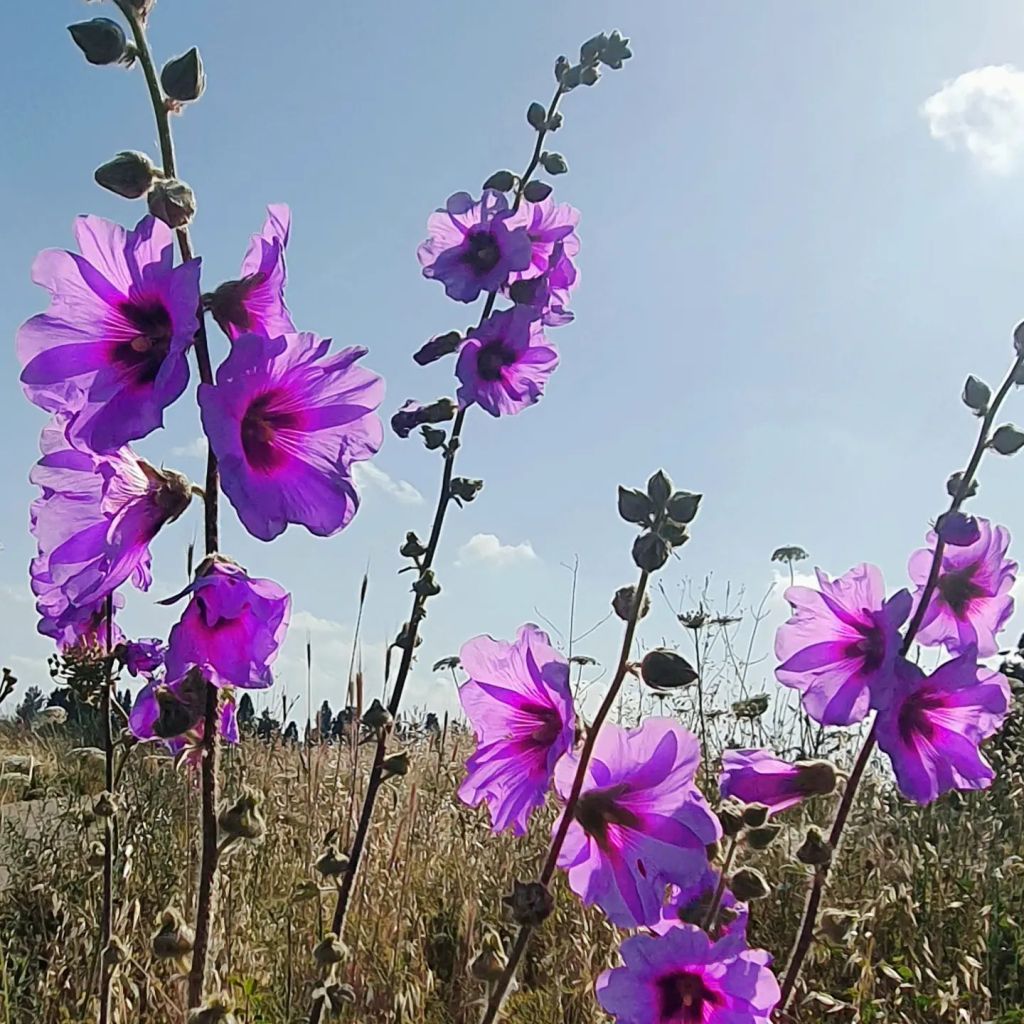
  • “You see”, she says, holding the metal fence, “where our house stood after the war. I remember in the front I had a garden… What is a garden, maybe even just a meter by meter. But I loved it so much. Mom would give me a few pennies and I remember going to the market and buying flower seeds from the peasants. My little garden was so beautiful and if someone had picked even one flower I would immediately burst into tears”. That’s how my mother describes the little garden that swept through the whole world of a girl in postwar Romania, a corner of beauty and quiet. Just hers. That was endlessly nurturing and nurturing. This is probably what motivated her to recruit all the neighbors in the housing we lived in after we left the kibbutz, weed out the wild, plant shrubs and flowers and lawn. And turn the arid slope in front of the house into a flowering garden. And so to this day, the garden is her happiness, her refuge. Even though there isn’t a single leaf that doesn’t go in the right direction. And where she sits down to smoke her daily cigarette (she claims to have one a day but who counts).

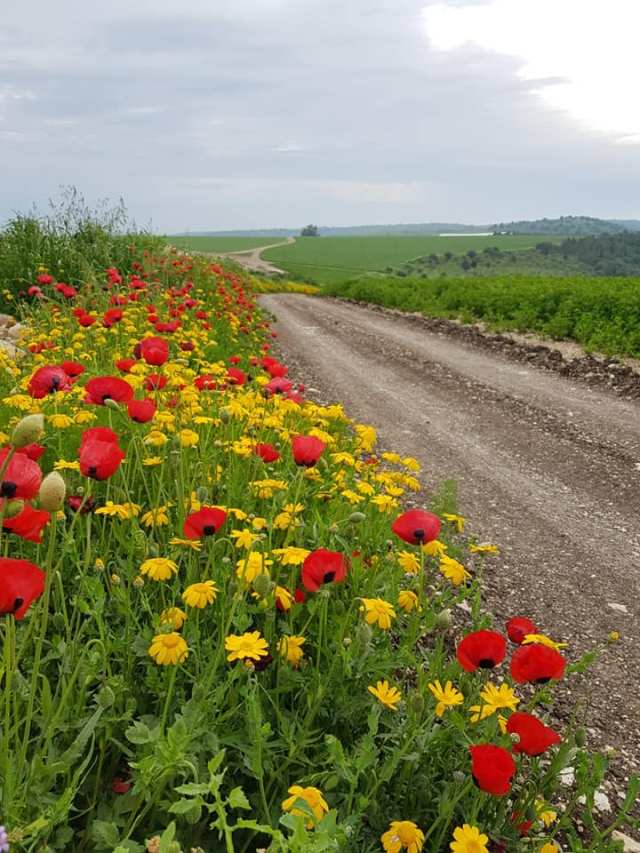
    Dad, for his part, moved from the village in Romania to what he called the “Kolhoz” in the Beit She’an Valley, near the “world capital”, the little town of Afula. He found his personal corner in the fields of the valley and throughout the Negev. Mounted on a tractor or combine, a reindeer fawn is discovered inside the harvested wheat. When they wanted himto go to study teaching at Ruppin, he found an excuse not to give up his great love of spaces and said it was suitable for those who could not go out into the field and work… The look he had in his eyes accompanies me every step of the way. Planted somewhere in the imaginary spaces, sailing far and wide. Going out to the fields to sell agricultural equipment was his finest hour. Sometimes I slipped out of school to accompany him, to study each line and plant, what each germ would look like and when each field would be harvested. The last time I drove him into a wheat field in late spring, he took a look of an experienced farmer and said, “In two weeks, we have to harvest…”

    Among the books, a yellowing brochure with the name “Ehud” on it. An older brother I didn’t know. How he loved nature, and was excited on trips withh the kids company and all that was going on in it. How he discovered the precursors of autumn rain, and dug into his fingernails to discover the onions and tubers they feed on. How he told everyone about the Sabbath trips with father and mother, jubilation towards each bird and every caterpillar, and knew how to give each one a name. What he read in the stars on the night walks, all enthusiastic. And even in the last photograph, Tu Bishvat, he plants a tree with the family, in a grove that will grow to glory near the brackish water canal.

    This love of nature and spaces. I seems to be running in the family. Even our youngest son was called a “jungke child” among the horse farm workers where he would ride and take care of the horses almost daily. His guide on the farm told us that he was amazing at his knowledge of plants and birds. When she asked him where all this knowledge was from, he told her that he had received it from his uncle, Ehud. When he was young, he would occasionally accompany me on field runs on bicycles. And when he started running himself we found ourselves going out on a Saturday night for an overnight run between the hills and streams in the area. I have no doubt that this connection to nature and spaces plays a big part in my love of long races on the ground.

  • When entering the ultramarathon experience I could tell it serves so many of my needs. Spending many hours in nature, improving my physical status (well… not always :-)), and a place when the mind cleans up and mental challenges are as exciting as the physical ones. After several races I was fortunate to have the courage and take the challenge of the Gobi March 2019, that was a whole new experience for me, fulfilling in so many ways. I went to Namibia for so many reasons, all were answered in a perfect symphony of nature, people, comradeship and kindness. I would like to dedicate this post for all those being on my mind out there during good and bad times on the course: My family and its incredible support along the journey, my parents (icl. dad RIP), friends, and every child I thought I may inspire by this journey – including that Perthes-child I was almost 50 years ago. Great thanks for my fellow competitors volunteers and RTP team, so many great souls, kind people, inspiring ones.

    *This post is for my non-Hebrew speaking friend. It is a rough translation of my story in Shvoong website. So here we go:

    A hundred and twenty kilometers into the race, the radiation is so strong that it is hard to see the pink flags marking the way against the backdrop of canyon rocks. A dense series of markings indicates a left turn and this is clearly the beginning of five kilometers of long, steep climbing in soft sand to the end point of the day. The temperature gauge attached to the compass scratches the 50-degree bar. Another bottle of isotonic, head down and keep pushing. An hour later, the joyful volunteers at the finish line will mark the end of day three of the race.

    The road to Namibia

    Three days earlier on the start line, a whole two years went through my head. Right after my first race in the 4Deserts series held in Mongolia’s Gobi desert, it was clear to me that this would be the next race. Everything worked like clockwork and then all of our lives were turned upside down. The first few months of 2020, and my personal preoccupation with synchronizing the handling of the crisis, the personal and family struggles, friends whose world and future were turned on them in an instant, and me… I clung to a run to maintain a small corner of sanity, allowing myself to run for an hour at midnight just to be called back. Stealing hours at noon in the hills near my house. The main thing was to get some air. How do you maintain a training routine? After the April 2020 race was postponed to October, it was postponed again to March 2021, and finally to October 2021. It is true that each of them had a full training program, but after the first cancellation, “projects” were introduced about a month before each event to give a purpose for the program even if the race was canceled. And so I got to “Rotate Ramon Crater”, “The Sanhedrin Trail”, and even go out to the sea-to-sea trail with Avishai.

    As the October 2021 race approached, everything seemed to really be taking place. Every step of progress towards it seemed like a miracle to me, and even on a plane to Addis Ababa in route to Namibia I waited to stand on the starting line to believe that everything was happening. Landing at Windhoek, shuttle on time and everything’s banging like clockwork. On the way to Swakopmund, I realized that the number of runners had shrunk to just over 30. The logistical depth of the “Four Deserts” series races is built for 100-150 participants in each race, so it was clear that it would be a slightly different race, with a different level of familiarity between the runners. Also, each of those who came carries experience and/or good reason to be here. When I found out I was sharing a tent with a Zimbabwean, and Ahmed al-Katiree from Dubai, I was even so happy. We’ll get back to the race…

    This was my second race in the Four Desert Series. A 7-day race of about 250 kilometers divided into stages in a 4-stage format of about 40 km, one long of 70-80 km followed by a day of rest, and completion of the distance on the last day. The uniqueness of the races is that they are also self supported, so everyone carries everything it takes for the whole week on their back, including the food (except for water). The backpacks usually weigh between 8 and 12 kg without the water. This time I stocked up on a new kind of backpack that did prove itself, and my equipment weighed about 10 kg. Also in the food, I made some changes including small bags of almonds and nuts that proved to be the culinary peak of the day.

    The day before the start, it turned out that they will be changing the course. Carlos, the course director, explained that there are 60-70 km/hr winds in the area of the first stage and the markings will not hold the migratory sands. Wind strength also puts runners at risk. I was disappointed that we might not be in the dunes, but I welcomed Carlos’ flexibility and experience, along with the ability to mark alternative routes in such a short time. As long as the race is to go ahead.

    The race begins

    On the first morning of the race we found ourselves 31 excited runners standing on the starting line. Recent tests that everything’s in place, the running-time snacks, the electrolytes, and also the mind aimed correctly. The team, volunteers and local staff are also excited about the very existence of the race. Just before the leap, Namibians of all colors stand and sing the local anthem together. Something that couldn’t happen 35 years ago. We don’t cry, but behind the sunglasses there are tears. The race is been run. To my left are the 28 flags that represent all the competitors and the volunteers also carry an Israeli flag next to the UAE flag.

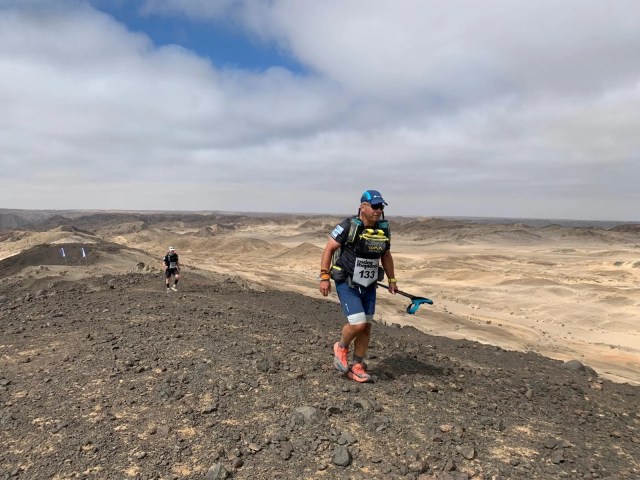
    On the first day, I’m very focused on pace control. Move forward like I’m on the last day, insist on not being dragged too fast. Up the Swakop River, the little mud in the first few kilometers changes very quickly with soft or partially compressed sand. I found myself near Russian Richard from Siberian talking about family and children. Later he picked up a beat, the two girls from Honduras and Guatemala overtook me, but I’m in pace: little by little. After 10 miles, I folded the sticks, and worked on the accuracy of the directions of the backpack to prevent shoulder pain and back rubbing. The other half of the day was mostly climbing from the dry river path, into temperatures up to 43 degrees. Hot, dry, sand, just the combination that makes me think about what I’m doing here. From the maps I remembered that the night camp is within the river route, and indeed 4 km before the end of the day I started to slide back down, until the abandoned ostrich farm, some of which were the ostriches that inhabited the gorge. The sunset over the night camp is great, dinner, preparations for the second day and an attempt to sleep most of the night.

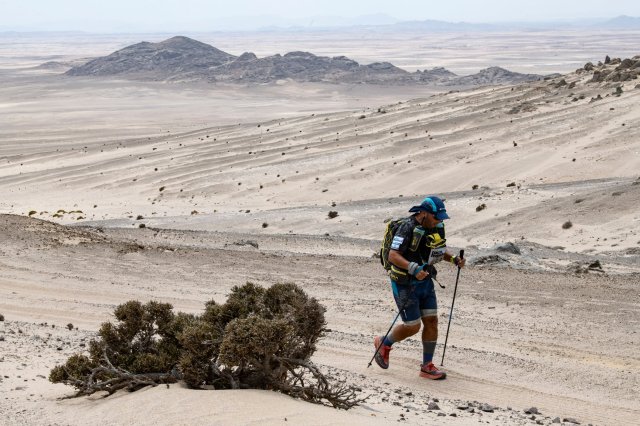
    Day two began with a long stretch of climbing into the moon valley. Some of it required ropes to pass dry waterfalls. At the end of the climb, just before the first control point, a look back reveals a crazy view, mirrors from another planet. Try to imagine the Israeli south Craters and Eilat Mountains area on steroids. Black mountains, huge granite rocks, quartz surfaces of different colors and hues ranging from deep purple to mustard yellow. The rest of the day was also taken from films on Mars with Welwitschia plants that are hundreds of years old. Before the second control point Jack was 500 meters ahead waved me goodbye. A mile later, I realized he had made a mistake on the way and reported Samantha – the point manager. A vehicle called in to look for him found him back on the track after realizing the mistake. The volunteers spray water from all directions. The hat feels like an air conditioner and the pants are dripping. For the furious temperatures, I’m not complaining. Between the second and third control points, I’m losing Jack again, who probably doesn’t feel at his peak. The fourth part of the day glides through a narrow canyon that is taken straight from a nature film to a meeting between the Swakop Gorge and the Kahan River Gorge (do not get too excited – both are dry). The encounter has enough moisture for fine vegetation and a baboon tribe that takes a distance from the human baboon camp. The local team celebrates with a big bonfire, I try to get a rest, take care of a small blister that starts to raise its head, and mostly remains overwhelmed by the times of the first quartet progressing faster than 10 km/hr! Led by Rob Ripley, a 60-year-old doctor from Oregon who will also win the race, with running abilities from another world.

    Tuesday’s morning briefing talks about 45 kilometers, most of which are moderate incline, and a sharper rise outside the gorge. The end of the day should mark the middle of the distance. They say it might be even warmer, partly because there’s no wind, but it’s nowhere near what’s really going to come. At the end of the first leg Jack comes after me and tells me he’s done and finishes the race. Given that I had already finished the first two bottles, it is clear to me that the heat is severe. Even the sun doesn’t cooperate and hits hard from the early hours. This day becomes an trench battle, and the vehicles are deployed between the control stations to provide water every 5 km. A wise decision not to look at the pace allows me to manage the effort carefully. At the third control station, the book of poems that Lilach prepared was pulled out. It’s time for it to contribute to the effort. A broken translation for volunteers, and Tiago the photographer wishes to commemorate the moment. I’ve already wrote about the last ascent. At camp, I tried to pick myself up, make sure I put in the daily calorie allowance, my body exhausted and I’m fighting to get another spoon and another spoon in. Tomorrow, they say, it is expected to be an easier day, mostly flat, just 42 km. Meanwhile, the 19-year-old Korean, the youngest of the runners, crosses the finish line in the dark in tears of joy, just as the cutoff time .

    Down the other half

    Day four marks the friendliest day of the race. A layer of clouds protects us all day, and a pleasant wind blows across the plains. Even the surface is less sandy. The need to avoid contact with the “milk bush” from which the bushman prepare the poison maintains a healthy alertness. I’m so happy about the weather and the pace spontaneously increases with longer running segments. Towards the end of the day I catch-up with Atul that accompanies Valdami, a blind Brazilian runner who has an impressive track record. We crossed the finish line of the day together with our hands crossed as road partners should. In the evening I started calculating times… There’s a chance to end under 50 hours cumulative! A little dream I suppressed so I wouldn’t make mistakes. Tomorrow the longest stretch, the long march, stretches over 68 km.

    Morning of the fifth day. Vigilance and excitement. A combination of the longest section and also the most significant last in the race. Aside from the front runners, many of us will end our day in the dark, navigating between the flags and the sticklighters. The heart wants to push to ensure enough space on the last day to finish under 50 hours, but the head dictates more cautious conduct. The first section is very fast, and the climb through purple and pink quartz surfaces to the high point of the day and the end of the second section also goes well. Here comes a descent through sand-slides and boulder climbing, which takes me almost half an hour per km. From here a new landscape opens again, temperatures are rising again but you can take comfort in the west wind. At the fifth point, after about 48 km I am offered coffee, you can’t say no to this, and this becomes a 20-minute stop, but every minute is golden. I turn on the red light on the back of the backpack and force myself to dig forward until the end. The sunset is wonderful and the cold starts to bother. Another buff on the neck, gloves are pulled out and the headlight is turned on. Between the sixth CP and the finish line, there were 10 kms. The head was in focus but the legs had will of their own and occasionally I zigzag. I pulled out the poles again to stabilize and I laughed out loud at the situation. Four kilometers from the end the dune area began. It was hard to see in the dark but the texture of the sand on the side hit by the wind gives them away. The finish line lights symbolize the beginning of a day of rest between the high dunes towards the short final stage. My times so far strengthen my desire to ensure an end to under 50 hours. Tomorrow morning we’ll wake up to a magical morning among giant dunes.

    The whole day of rest was about arranging the equipment and getting rid of food that is not essential. My surplus food goes to other runners . Rest in the shade and long conversations with the competitors who became friends. Carlos can be seen with his crew members working on the final markings of the track in the dunes.

    On the last day, the start is late. Coffee and two snacks, there’s no point in eating much because at the end there’s cold beer and pizzas… Running in the dunes, I tried to work smart through the compressed side of the dune with skating steps. The business works really nice and I was able to run large parts of the section. The wind already carries a smell from the Atlantic coast that is clearly visible. The sand on the beach is deep purple. To anyone who asked why I wasn’t smiling in the closing picture: less than a mile from the end, the throat choked with excitement. On the finish line: celebration, hugs, smiles, introduction to the family of Mabasa, pizzas, 3 beers, I’m set. Catching my breath so I wouldn’t fall apart on the phone, I called Lilach.

    What now?

    You can’t really describe in words the intensity of the experience, all the little moments, and the inspiring people I met. I write now as everything is fresh, but from my experience I know that the experience will resonate with me for a long time to come. The people, the competitors, the volunteers, the race team. Each with their own special story. Long months from the stage of the idea, the organization, the physical and mental preparations that drain into the peak event. Endless moments of falling into the abyss and ascension. Looks marvel at the intensity of the desert, and long minutes of silence that penetrates and cleanses the soul. The family photo on the phone that accompanied me every night, and the songbook that was anchored every time. This is where I feel at peace.

    So many people have accompanied me this way, and everyone deserve a huge thank you. Nonprofits that have been before my eyes more than once in the track: Yadid Lachinuch (friend of education) and Perthes Israel, each in its own way paves the way for capableness. Pano Koter who knows how to guide me without digging, as I like. And my amazing amazing family with my private orchestra conductor, my beloved teacher Lilach.

    And in the “what now?” thing, obviously I’m already thinking about the next challenge… There’s a chance he’s already in the log… It’s going to be fun.

    Now a little rest, and in the meantime, you can use the time and contribute:

    Donations to education friend Yadid Lachinuch https://www.yadidla.org.il/ to 563317 account, at the 640 branch of Bank Hapoalim.

    Perthes Israel https://www.perthesisrael.com. For further donations and details, please contact Tali Ben-Dror and Merav Bar-El Meirav Bar-el 050-2340003 /052-8582000